Key takeaways
- Parmigiano Reggiano PDO can only be made in Parma, Reggio Emilia, Modena, the part of Bologna west of the Reno river and the part of Mantua south of the Po, from raw cow’s milk, with no additives.
- The minimum aging is 12 months, and every wheel is inspected by the Consortium before it may carry the name.
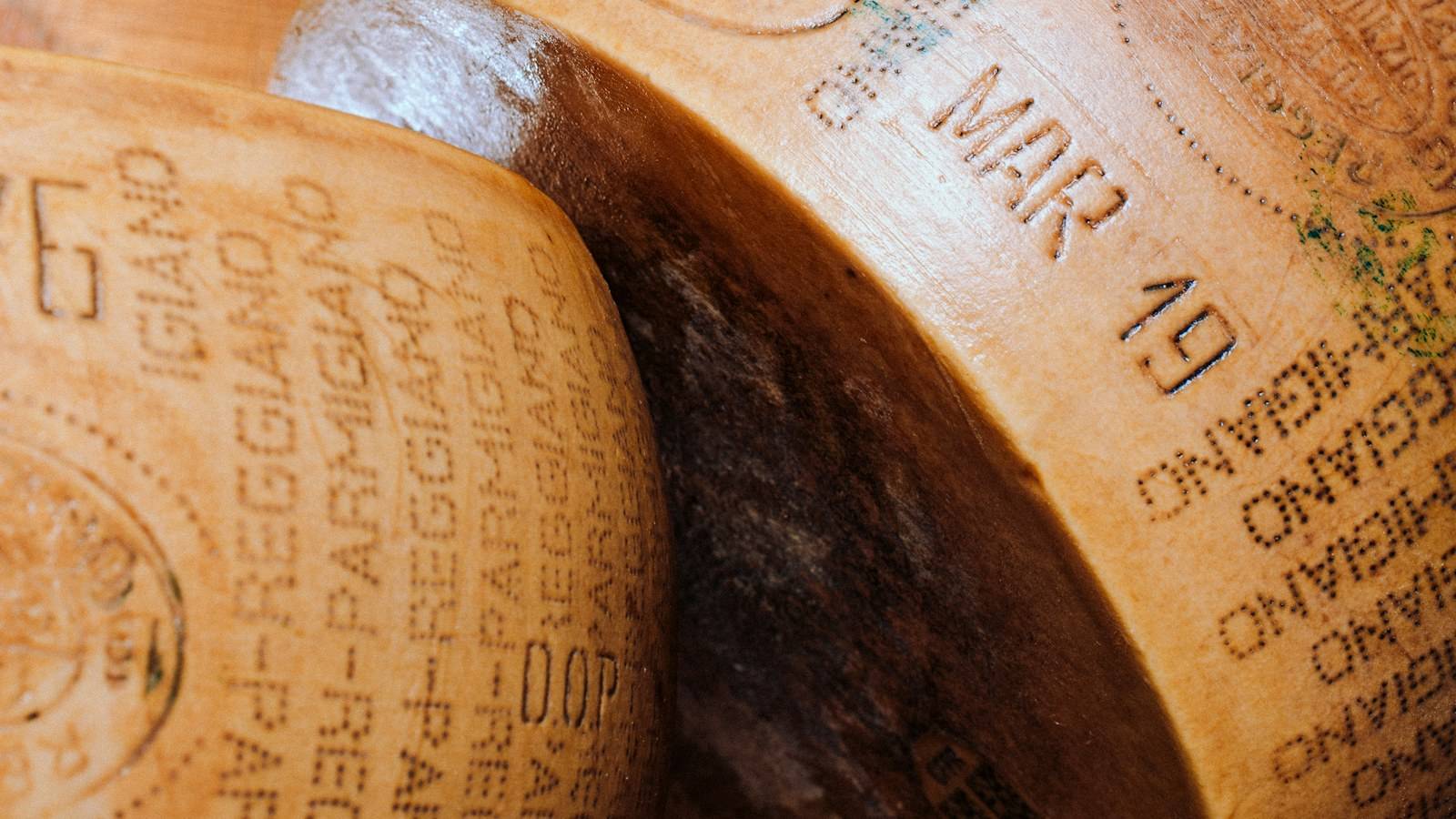
- A genuine wheel carries three marks: the pin-dot lettering around the rind, a numbered casein plate, and the oval fire-brand applied after inspection.
- Aging grade decides the channel: 12 to 18 months for everyday retail, 24 months for the deli counter, 30 months and above for specialty and gifting.
- US import is straightforward for this cheese, because the 12-month minimum aging clears the 60-day rule that applies to raw-milk cheeses.
- Our minimum is one pallet, mixed across products and producers, so a first order can combine Parmigiano Reggiano with other lines instead of committing to volume on one.
What the Parmigiano Reggiano PDO Actually Protects
The name is tied to a place and a method, not to a recipe anyone can follow. Production is limited to the provinces of Parma, Reggio Emilia and Modena, the part of Bologna west of the Reno river, and the part of Mantua south of the Po. The milk is raw cow’s milk from herds in that area, partly skimmed, turned with calf rennet and natural whey starter. No additives are permitted.
A wheel weighs around 40 kg. It is salted in brine and then aged on wooden boards for a minimum of 12 months, and only then does it face inspection.
This matters commercially for one reason. Everything that makes the cheese expensive is fixed by the rules, so nobody can undercut the category by changing the method. What you are choosing between is aging, format and supply reliability.
Summarize this article with AI
The Three Marks That Prove a Wheel Is Real
Buyers who are new to the category often ask how they can be sure. There are three marks, and a buyer can check all of them on arrival:
- The pin-dot lettering rolled around the whole rind, repeating the name and the dairy’s registration number with the month and year of production.
- A numbered casein plate pressed into the rind, which gives the individual wheel a unique identity.
- The oval fire-brand, applied only after the Consortium’s inspection at 12 months. A wheel that fails inspection has its rind marks removed and cannot be sold under the name.
If you buy pre-cut wedges rather than whole wheels, ask for the lot documentation that ties the cut back to a marked wheel. That paperwork is what your own customers’ compliance teams will ask for.
Which Aging Grade Should You Buy?
Aging is the single decision that changes the price, the texture and the shelf position. This is the practical guide we give buyers:
| Aging | Texture and flavour | Where it sells | What to watch |
|---|---|---|---|
| 12 to 18 months | Milder, milkier, still elastic, easy to portion | Everyday retail, grated and shredded lines, foodservice recipes | The cheapest entry, but it is not what a specialty buyer means by Parmigiano |
| 20 to 24 months | The classic profile, grainy, crystals starting, nutty | Deli counters, cheese boards, premium retail wedges | This is the volume grade for most importers |
| 30 months | Drier, more crystalline, longer finish | Specialty retail, restaurant cheese trolleys | Lower yield per wheel once cut, price rises faster than the calendar |
| 36 months and above | Very dry, intense, crumbles rather than slices | Gifting, tasting programmes, fine dining | Small volumes only, and it should be ordered against a confirmed customer |
Formats, Yield and How It Ships
The whole wheel is the reference format, at around 40 kg. From there it is cut down: halves, quarters, and eighths of roughly 4 to 5 kg that a deli can open and cut to order. Retail wedges are vacuum packed in fixed weights. Grated and shaved packs exist for foodservice, and they travel best when the pack is nitrogen flushed.
Two practical points. First, every cut stage costs yield, so a wedge programme will always price higher per kilo than wheels. Second, this is a chilled product, not a frozen one, and it ships in a reefer container at chilled temperature alongside other chilled Italian lines.
If you are building a first container, our guide to mixed pallets and freight cost explains why combining Parmigiano Reggiano with cured meats and olive oil brings the logistics cost per kilo down.
Importing Parmigiano Reggiano into the USA
Raw-milk cheese may be imported into the United States when it has been aged at least 60 days. Parmigiano Reggiano is aged a minimum of 12 months, so the aging rule is not the obstacle here. The rest of the process is the standard one for food imports: the producing dairy holds an FDA food facility registration, you as the importer meet your FSVP obligations, Prior Notice is filed before arrival, and a licensed customs broker files the entry. We set that sequence out in full in our guide to importing food from Italy to the USA.
What does catch buyers out is the label. The PDO protects the name inside the EU, and a US shelf can legally carry a domestic hard cheese labelled “parmesan”. Your case for the real thing is the marks, the aging statement and the origin, which is exactly why the three marks above are worth explaining to your own sales team.
What Documents Come With the Shipment
A Parmigiano Reggiano shipment travels with a commercial invoice and packing list, a certificate of origin, the health certificate the destination requires, the producer’s specification sheets with aging and lot data, and the PDO documentation tying the goods to registered wheels. We prepare the origin and food-safety paperwork before the container sails, so your broker is not waiting on Italy while the box sits at the port.
Ordering at a Realistic Volume
Our minimum is one pallet, mixed across products and producers. For a buyer testing Parmigiano Reggiano, that usually means a wheel or two in the grade you want to sell, a quantity of pre-cut wedges to see how the format performs at the counter, and other chilled or ambient lines to fill the pallet. We consolidate from several producers into a single shipment with one set of export documents.
If the reorder is what you are worried about rather than the first order, that is the right instinct, and we cover it in the minimum order quantity guide.
Working with ALL-FOOD
ALL-FOOD is a dedicated Italian export office based in Tuscany. For Parmigiano Reggiano we work with Consortium-registered dairies, check the goods before they ship, and handle export documentation and consolidation for importers, distributors and retail buyers in the USA, Canada, Australia, the Middle East and South America. Tell us the grade and the format your Italian cheese channel needs and we will match the dairy. Get in touch with our team to discuss your product needs.
Frequently asked questions
Where can Parmigiano Reggiano PDO be produced?
In the provinces of Parma, Reggio Emilia and Modena, the part of Bologna west of the Reno river, and the part of Mantua south of the Po. The milk must come from herds in that area.
How long is Parmigiano Reggiano aged?
A minimum of 12 months, after which the Consortium inspects every wheel. Common commercial grades run from 12 to 18 months up to 36 months and above.
How can I tell a genuine wheel from an imitation?
By three marks: the pin-dot lettering around the rind, the numbered casein plate, and the oval fire-brand applied after inspection. For cut product, ask for the lot documentation that ties the cut back to a marked wheel.
Can raw-milk Parmigiano Reggiano be imported into the United States?
Yes. Raw-milk cheese may be imported when it has been aged at least 60 days, and Parmigiano Reggiano is aged a minimum of 12 months.
Which aging grade sells best at retail?
20 to 24 months is the volume grade for most importers. Younger grades suit grated and foodservice lines, and 30 months and above suits specialty and gifting.
What formats do you ship?
Whole wheels of around 40 kg, halves, quarters, eighths of roughly 4 to 5 kg, vacuum packed retail wedges, and grated or shaved packs for foodservice.
What is your minimum order for Parmigiano Reggiano?
One pallet, mixed across products and producers, so you can take Parmigiano Reggiano alongside other Italian lines at entry volume.

About the author
Giorgio Morocica
Export Manager at ALL-FOOD
Giorgio leads export operations at ALL-FOOD, sourcing and shipping authentic Italian food for importers, distributors and retail chains across the USA, Canada, Australia, the Middle East and South America. He writes about the sourcing, compliance and logistics questions buyers actually run into.
Connect on LinkedIn