Key takeaways
- Prosciutto di Parma DOP and Prosciutto di San Daniele DOP are both made only from Italian pork legs and salt, with no additives, but they are two separate protected designations with separate rules.
- Parma is cured in the hills of the province of Parma in Emilia-Romagna. San Daniele is aged in the town of San Daniele del Friuli in Friuli-Venezia Giulia.
- Minimum ageing is 14 months for Parma under the current specification and 13 months for San Daniele. For San Daniele we guarantee 15 months and up.
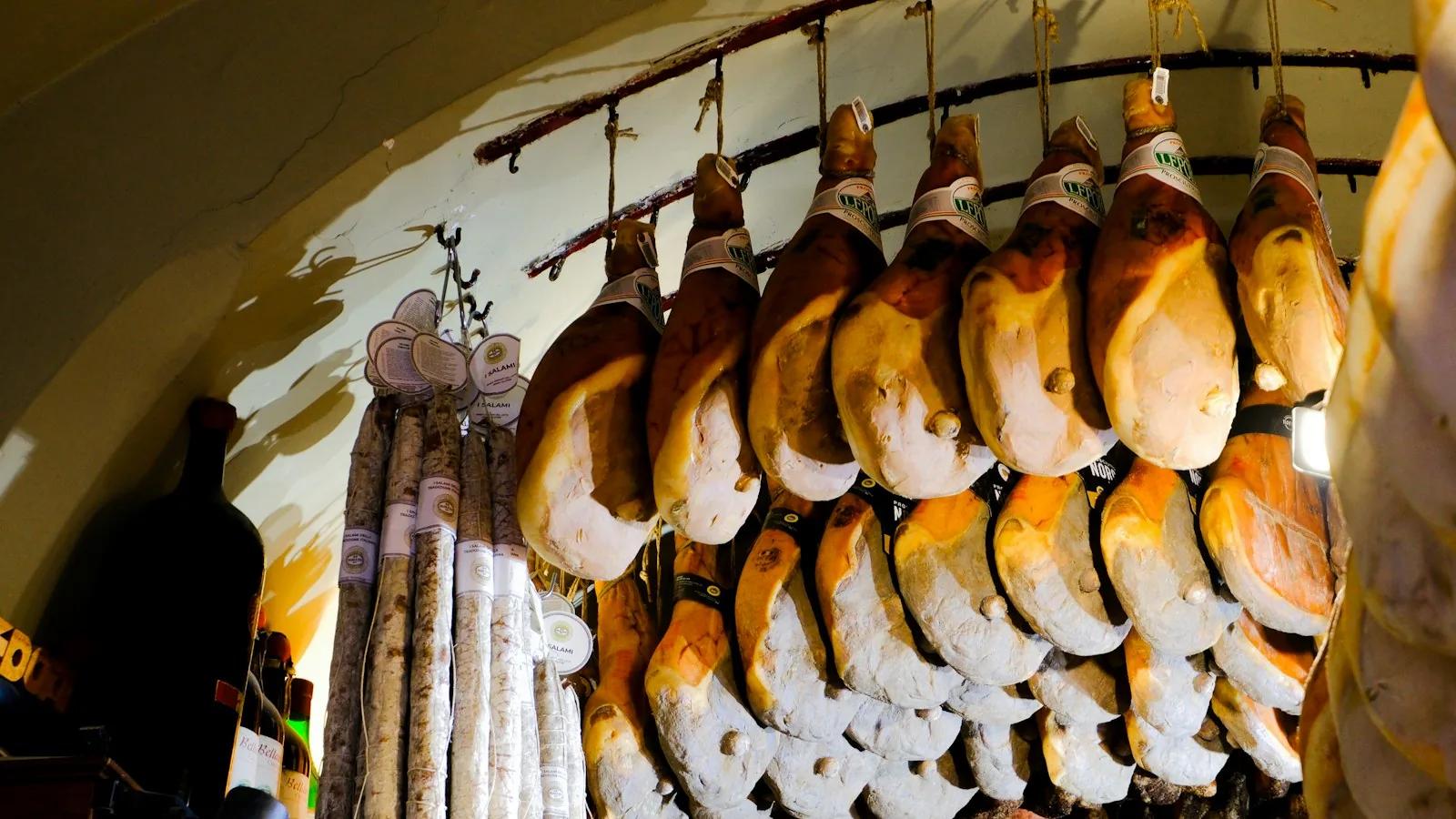
- You can tell them apart on the counter: San Daniele keeps the trotter and is pressed into a guitar shape, while Parma has a rounded shape. Each carries its own fire-branded mark.
- For the United States and Canada, eligibility is decided by the producing establishment, not by the name on the leg, so check the plant before you choose the ham.
- Both are sold separately from our own San Chimento salumi range.
Two hams, two designations
Buyers often treat Parma and San Daniele as the same product with different names. They are close relatives: both are dry-cured, both use only pork and salt, and both come from heavy Italian pigs. But each has its own consortium, its own production area, its own specification and its own mark, and a buyer who lists one should be able to say why it is not the other. The difference that matters commercially is not which ham is better. It is which one your channel can explain and sell at the price it needs.
Summarize this article with AI
Prosciutto di Parma vs San Daniele side by side
This is the comparison to give your own sales team:
| Prosciutto di Parma DOP | Prosciutto di San Daniele DOP | |
|---|---|---|
| Where it is made | The hills of the province of Parma, Emilia-Romagna | The town of San Daniele del Friuli, Friuli-Venezia Giulia |
| Ingredients | Italian pork legs and salt only | Italian pork legs and sea salt only |
| Minimum ageing | 14 months under the current specification | 13 months (we guarantee 15 months and up) |
| Shape | Rounded, without the trotter | Pressed into a guitar shape, with the trotter left on |
| Mark | Fire-branded ducal crown | Fire-branded San Daniele mark |
| Flavour | Sweet and delicate | Sweet and delicate, often described as slightly more aromatic |
| Typical channel | Deli counters, premium retail and foodservice, the name most shoppers recognise | Specialty retail and deli counters where the counter staff can tell its story |
How to tell them apart on the counter
The fastest check is the shape. A whole San Daniele leg keeps its trotter and is pressed during curing, which gives it the flattened guitar shape. A whole Parma leg has a rounded shape without the trotter. The second check is the mark. Each consortium fire-brands its legs after inspection: a ducal crown for Parma, the San Daniele mark for San Daniele. If you buy boneless or sliced product, ask for the lot documentation that ties it back to marked legs, because that paperwork is what your own customers’ compliance teams will ask for.
Which one should your channel buy?
For most importers the answer is not one or the other. Parma is the name an American, Canadian or Middle Eastern shopper already knows, so it carries the volume at the deli counter and in pre-sliced retail. San Daniele is the second ham that gives a specialty counter something to talk about, and it earns its place where staff can explain the difference in a sentence. If you are starting from zero, start with Parma for volume and add San Daniele once your counter can sell a comparison. If your customers are specialty retailers, the two side by side is the offer.
Formats and specification
Both hams ship as whole legs on the bone, as boneless legs, and as pre-sliced packs. Within boneless there is a further choice between hand-deboned and pressed hams, and between skin on and skin removed, and each choice changes yield, labour at destination and price per usable kilo. We explain those choices, and the seasoning we quote, on our Italian cured meats page. Specify the seasoning against your transit time and your channel, not against the lowest number a retailer will accept.
Importing into the United States and Canada
For the United States, Italian pork products enter only from establishments on the FSIS list of eligible plants for Italy, and the conditions are not the same across every Italian region. Both Parma and San Daniele sit in regions with specific conditions, so the plant check comes before the choice of ham. We set out how that works in our guide to which Italian cured meats can enter the USA. For Canada, cured meats must come from an establishment approved for export to Canada, with a health certificate from the Italian veterinary authorities on every shipment. Our guide to importing Italian food into Canada covers the full sequence.
Where speck fits
Speck is often listed next to prosciutto, but it is a different product. Prosciutto di Parma and San Daniele are air-dried and never smoked. Speck from Alto Adige is boned, cured with spices such as juniper and pepper, and lightly cold-smoked, which gives it a firmer texture and a smoky flavour. It sells to a different shopper and a different use, so treat it as an addition to the range rather than a substitute. Speck is part of our own San Chimento range.
Ordering at a realistic volume
Our minimum is one pallet, mixed across products and producers. That means you can take Parma and San Daniele together, alongside other Italian lines, and find out which one your customers reorder before you commit to a full programme.
Working with ALL-FOOD
ALL-FOOD is a dedicated Italian export office based in Tuscany. We supply whole Prosciutto di Parma DOP and Prosciutto di San Daniele DOP, check the specification before the goods ship, and prepare the export documentation for importers, distributors and retail buyers in the USA, Canada, Australia, the Middle East and South America. Tell us the ham, the format and the market, and we will confirm the eligible establishment and the seasoning up front.
Frequently asked questions

About the author
Giorgio Morocica
Export Manager at ALL-FOOD
Giorgio leads export operations at ALL-FOOD, sourcing and shipping authentic Italian food for importers, distributors and retail chains across the USA, Canada, Australia, the Middle East and South America. He writes about the sourcing, compliance and logistics questions buyers actually run into.
Connect on LinkedIn