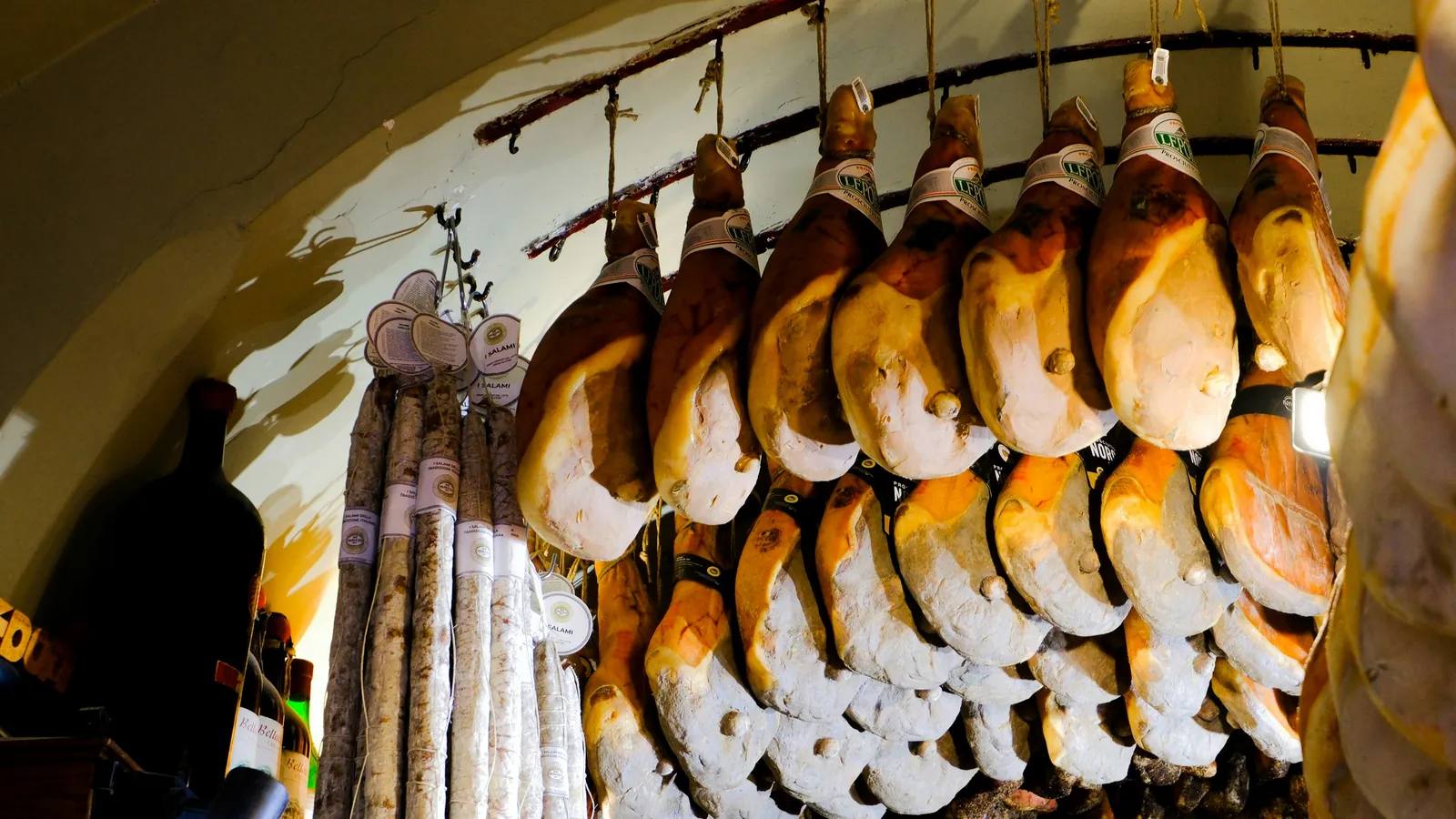
ALL-FOOD is an Italian sourcing and export office, not a producer. We supply Italian cured meats to importers, distributors, wholesalers and retail buyers: whole Prosciutto di Parma DOP and Prosciutto di San Daniele DOP, and a full range of cold cuts and salumi under our own San Chimento brand. We select the product, agree the specification with the producer, check the goods before they ship and prepare the export documentation.
Key takeaways
- Whole DOP hams are specified, not just ordered. Bone-in or boneless, hand-deboned or pressed, skin on or removed, and each choice changes how the product behaves on your counter.
- Seasoning should be specified against your transit time and your channel, not against the lowest number a retailer will accept.
- For San Daniele we guarantee 15 months and up, because the product moves to our establishment before it ships and that step consumes roughly a month.
- Boneless vacuum ham typically carries about six months shelf life. Bone-in, not vacuum packed, typically a year.
- Removing the skin shortens the life of the ham dramatically once it is opened on the counter, from roughly a week to a few days.
- Destination-language labelling is applied differently depending on whether the ham is bone-in or boneless.
Whole Prosciutto di Parma DOP and San Daniele DOP
Whole hams are the part of this category that buyers most often under-specify. Two retailers can order the same DOP ham and receive products that behave completely differently on the counter, because the specification is where the real decisions sit.
We supply Parma DOP and San Daniele DOP as whole pieces, bone-in and boneless. Bone-in tends to be a seasonal in-and-out line, strongest towards the end of the year. Boneless is what usually earns a permanent listing, because it is easier to handle and easier to slice consistently.
Bone-in or boneless
Bone-in keeps the ham whole and is the display piece. It ships not vacuum packed, two pieces to a carton, with aluminium protection on the bone, and typically carries about a year of shelf life.
Boneless ships vacuum packed and typically carries about six months. It is the format most retail counters settle on.
Both shelf life figures are typical for the format rather than a guarantee, and we confirm the actual dates per shipment.
Hand-deboned or pressed
There are two ways to bone a ham and they produce different products at the same price.
The first is deboned by hand. The bone is cut around slowly and removed, the ham keeps its original shape, and it is closed in a net. It looks like a ham and it displays like one.
The second is filled after deboning and then pressed into a uniform mould. It loses the natural shape and gains something a slicing operation cares about more: every slice is the same size, from the first to the last, with no waste at either end.
If the ham is going on a counter to be sliced to order, pressed is usually the right answer. If it is a display piece, hand-deboned is.
For operations slicing very high volume there is also a block format, which slices start to finish with no waste at all.
Skin on or skin removed
Boneless ham ships with the skin on as standard. Removing the skin is an additional processing step and it is available, but it is rarely the right choice for a retail counter.
The reason is what happens after the ham is opened. A standard ham, once opened on a counter, holds for roughly a week to ten days. With the skin removed, that drops to two or three days. Unless the counter turns a whole ham in that window, the skin stays on.
These are working estimates rather than guaranteed figures, and they depend on the counter's own conditions.
Why seasoning is a specification, not a price lever
Seasoning is where buyers most often negotiate down and most often regret it.
A retailer comparing offers will tend to ask for the lowest seasoning available, because it is the cheapest version of the same named product. What that misses is that the number on the technical file and the invoice is the age of the ham when it leaves Italy, not when it reaches your counter.
For San Daniele we guarantee 15 months and up rather than quoting the base figure. There are two reasons. The product moves from the San Daniele area to our establishment before it ships to you, and that in-house step consumes roughly a month, which we would rather carry ourselves than pass to you as a surprise. And we have had the experience before of a customer buying at the lowest available seasoning on price, receiving a ham that tasted too fresh, and opening a complaint.
Parma is quoted across more than one seasoning level, including longer-aged product, because different channels want different things. The point is not that longer is always better. It is that seasoning should be chosen against your transit time and the expectations of your customer, and agreed in writing before the price is fixed.
San Chimento, our own cured meats brand
Alongside the DOP hams we supply a full range of Italian cold cuts under San Chimento, which is ALL-FOOD's own brand. We own the brand and set the specification, and production is carried out for us by established Italian salumifici.
The range covers prosciutto crudo and prosciutto cotto, salami, pancetta, bresaola, mortadella, roast meats and specialities. Importers get a consistent range under one label with the documentation prepared in Italy before the pallet leaves.
Labelling for your market
Destination-language labelling is mandatory in most of the markets we ship to, and the format depends on the product.
On boneless vacuum packed ham, the label is applied directly to the product. On bone-in ham a sticker will not hold, so the label is applied as a hang tag instead. This sounds like a detail until a shipment arrives in the wrong format and cannot be put on the shelf.
Tell us the destination market at the quotation stage and we confirm the format before production rather than after.
Shipping Italian cured meats to your market
Cured meats carry market access requirements that go beyond the product itself, including establishment listings and regional eligibility rules that differ by destination. Our guide to Italian cured meats for US importers covers the US position in detail.
If you want a programme under your own label rather than ours, that runs through our private label service.
Frequently asked questions
Yes, as whole pieces, bone-in and boneless. Bone-in tends to be a seasonal in-and-out line and boneless is what usually earns a permanent listing.
A hand-deboned ham keeps its original shape and is closed in a net, which makes it the better display piece. A pressed ham is filled after deboning and pressed into a uniform mould, so every slice is the same size with no waste at either end. The price is the same.
Usually not for a retail counter. A standard ham holds roughly a week to ten days once opened, and with the skin removed that drops to two or three days. It only makes sense if the counter turns a whole ham in that window.
We guarantee 15 months and up. The product moves to our establishment before it ships and that step consumes roughly a month, and we have previously seen complaints where a customer bought at the lowest available seasoning and found the ham too fresh on arrival.
Bone-in, which ships not vacuum packed, typically about a year. Boneless, vacuum packed, typically about six months. Both are typical for the format rather than guarantees, and actual dates are confirmed per shipment.
Yes. On boneless vacuum packed ham the label is applied directly to the product. On bone-in ham it is applied as a hang tag, because a sticker will not hold. Tell us the destination market at the quotation stage.
Discuss your Italian cured meats requirements
Tell us your market, your formats and your business type, and our team will come back with the product details, specifications and documentation you need.