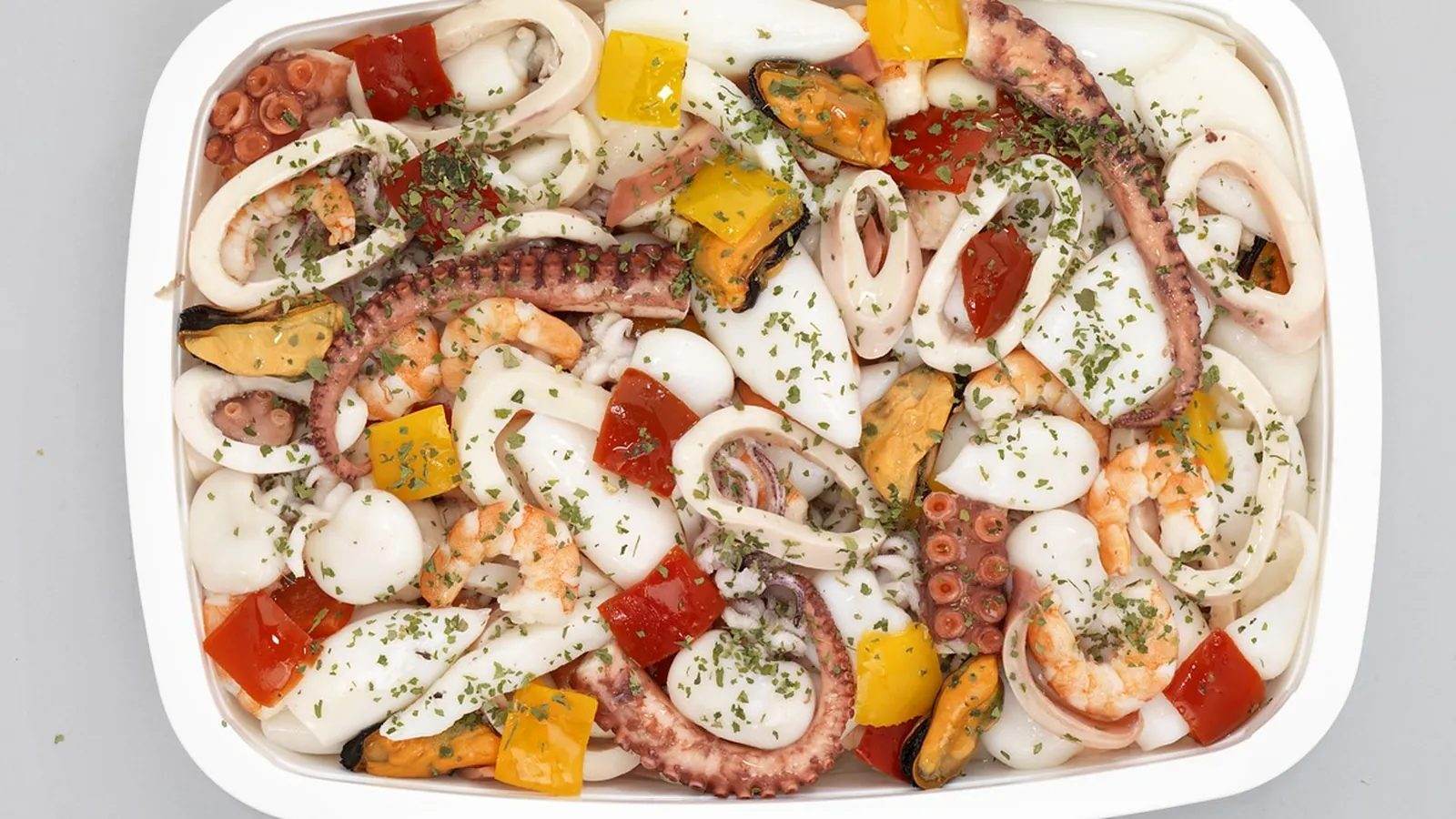
At a glance
- Product: Five chilled marinated seafood references in 200 g retail trays, private label
- Producer: LOCAS, SFDA-approved establishment CE IT 569
- Buyer: A Saudi retail group operating more than seventy stores across the Kingdom
- Market: Saudi Arabia
- First order: 150 cartons, five references
- Timeline: Ten weeks from first enquiry to confirmed purchase order
- ALL-FOOD role: Producer sourcing, SFDA documentation, prohibited-ingredient screening, Arabic label coordination, sample logistics, vendor onboarding
The challenge
In October 2025 the quality and inspection office of a major Saudi retail group contacted us about a range of Italian marinated seafood. They had a shortlist. They wanted samples. And before any of that, they wanted one thing confirmed: was the producer registered with the SFDA as an approved fish exporter to the Kingdom, and could we send the certificate.
That question is where most European food exporters lose a Saudi buyer. Not on price, not on product quality, but on a single line of documentation that either exists or does not, and cannot be created quickly if it does not. An Italian producer who has never sold into Saudi Arabia is not on the list, and getting onto it is a process conducted between national competent authorities, not between a supplier and a customer.
Saudi food import control is often described as if it were one approval. It is not. It is four sequential gates, each with its own document set and its own failure mode. The manufacturing plant must appear on the SFDA list of approved establishments for its product category. Every individual SKU must carry its own SFDA product registration number. The importer must hold an import permit supported by a six-month export plan naming each product by scientific species name. And the retail label must be rebuilt in Arabic to the Saudi nutrition format rather than translated from the European one. Clearing one gate tells you nothing about the next.
Underneath all of that sat a harder problem, which did not appear until week five. The products are chilled, stored between 0 and +4 °C, and most of the shortlisted references declared a shelf life of 120 days. At 120 days, sea freight from Italy to Jeddah plus the remaining shelf life the buyer needs on arrival does not work. The only viable mode was air. And the buyer, it turned out, had no air route for chilled fish out of Italy at all. Their Italian suppliers ship by sea into a consolidation point.
The project was, at that moment, commercially stuck. Air was the only mode the product could survive and the only mode the buyer could not operate. This is the kind of problem that ends most enquiries into the Gulf, and it is why we treat compliance and logistics as one job rather than two on every Middle East market page enquiry we handle.
What ALL-FOOD did
Confirmed the establishment accreditation in twenty-four hours
Our seafood partner, LOCAS, appears on the official SFDA list of Italy-approved establishments for the export of processed fish and aquatic products to the Kingdom of Saudi Arabia, under approval number CE IT 569, listed since December 2024 and active. The certificate went to the buyer’s inspection office the day after they asked.
That list records the approval number, the plant’s city and region, the type of process, the scientific name of every fish used and the trade name of every product. Our producer’s entry carries a technical condition: the products have a pH below 4.4 and require refrigeration. That is not a footnote. It is the regulatory basis on which the category was approved, and it has to stay consistent with what the technical sheets declare. Every technical sheet in this project reports pH measured by method NMKL 179 at 4.4, which is precisely why the products qualify.
If the plant is not on the list, there is no route to market. Not a slow route. No route. Checking this first, before any commercial discussion, is the single highest-value thing a buyer can ask of a supplier.
Completed the product registration file
An approved plant does not give you approved products. Each reference must be registered with the SFDA in its own right and receives its own product registration number. Five references were registered in this project, each returning a distinct code before the buyer would issue a purchase order.
The registration file ran to more than thirty columns per SKU: brand, item code, full product description, complete ingredient declaration, the full nutrition panel, organic status, EAN barcode, net content and drained net content as separate figures, shelf life, required shipping temperature in degrees Celsius, country of manufacture and country of origin as two separate fields, front and back product photography, front and back label artwork, pack format, units per box, boxes per pallet, total units per pallet, minimum order quantity, FOB pricing, order quantity and total value.
Every field is a potential rejection. The buyer will not submit a file with gaps, because a rejected registration costs them time with their own regulator.
Completed the import permit file and six-month export plan
The import permit application is a bilingual Arabic and English form on the importer’s own letterhead, supported by proof of payment of the permit fee, a copy of the importer’s commercial register, a copy of the invoice or proforma, and a six-month export plan.
The export plan is the document most exporters have never seen. Per product it declares the product name, the weight of a single carton, the number of cartons to be shipped across six months, the resulting total weight, the monthly production capacity of the exporting facility, the percentage of that capacity allocated to the Saudi market, and the quantity expected to be exported each month. One plan covers one exporting facility, one country of origin and one port of entry. Mixing facilities or ports on a single plan invalidates it.
Products must be named by scientific species, not by commercial description. Saudi Arabia does not accept “squid”. The plan we completed names Dosidicus gigas, Uroteuthis duvaucelii, Sepia pharaonis, Engraulis encrasicolus, Sardinella aurita, Litopenaeus vannamei and a dozen more, each mapped to the commercial product it appears in. Getting this wrong is not a translation problem. It is a false declaration.
Rebuilt the label in Arabic
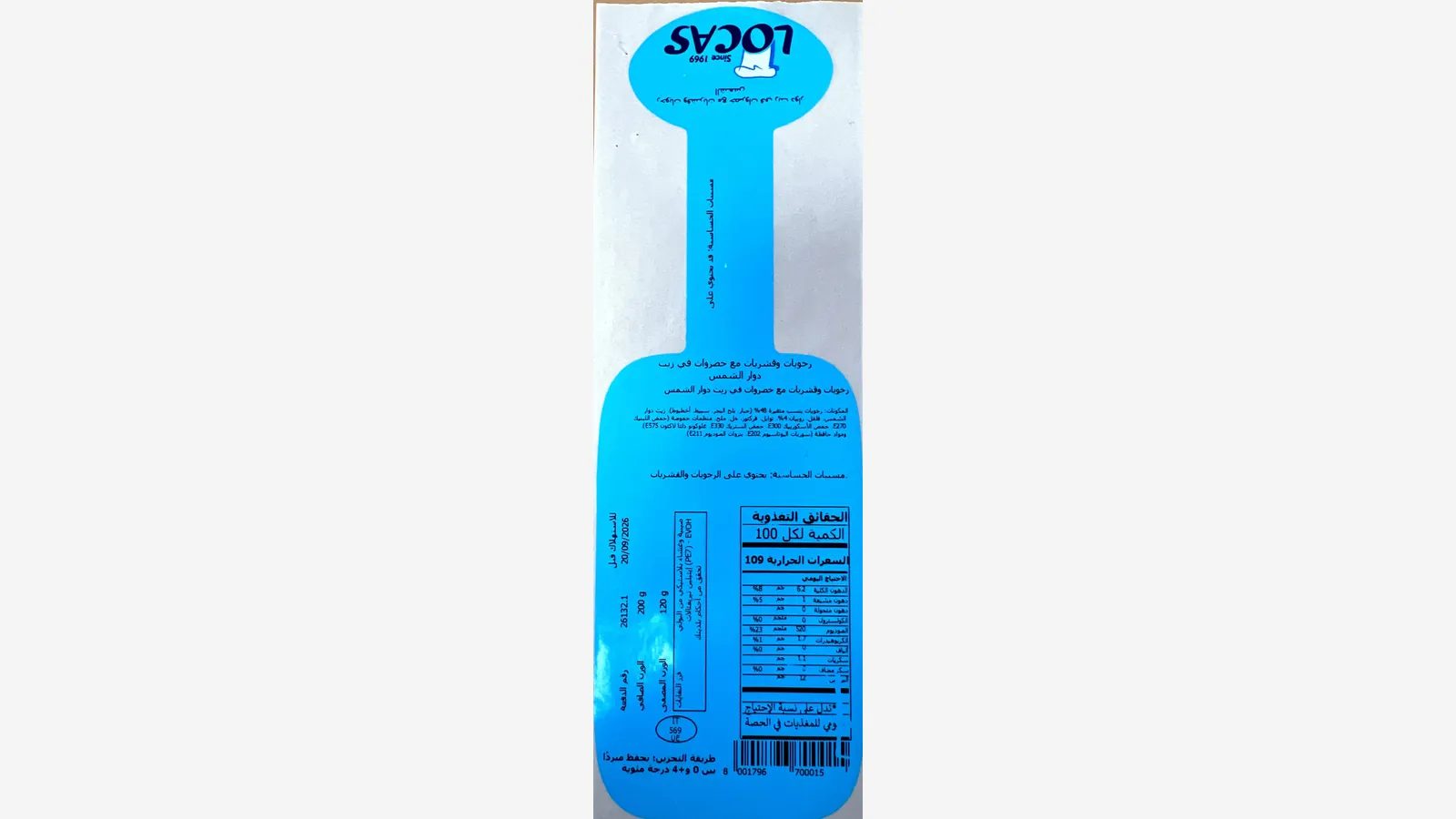
This is where most projects underestimate the work. The Saudi retail label is not the European label with Arabic text added. It is built to a different nutritional model.
The European label on these products declares average nutritional values per 100 g of drained product: energy in kilojoules and kilocalories, fat, saturates, carbohydrate, sugars, protein and salt in grams. The Saudi label declares a percentage Daily Value panel referenced to a 2,000 kcal diet, and adds lines the European label does not carry at all: trans fats, cholesterol, dietary fibre, added sugars, and sodium expressed in milligrams rather than salt in grams.
The difference is not cosmetic. On the seafood appetizer, the European label reads 0.59 g salt; the Saudi label reads 236 mg sodium at 10% Daily Value. On the marinated anchovy fillets, 2.4 g salt becomes 960 mg sodium at 42% Daily Value. Same product, same recipe, two incompatible panels.
The Arabic label also carries a mandatory allergen declaration distinguishing “contains” from “may contain” in both languages, net and drained weight in both scripts, the producer name transliterated into Arabic, and separate production and expiry date fields. Because this was a private label programme under the buyer’s own brand, the artwork went through several rounds with their quality team before sign-off.
Caught two documentation errors before they reached the regulator
The value of a dedicated Italian export office is rarely visible in the things that go right. It is visible in the things that were about to go wrong.
The word “wine.” The buyer sent a list of ingredients prohibited under Saudi import rules, covering wine, alcohol, pork, rum, ginseng, poppy seeds, hemp and nutmeg, along with specific additives including E102, E110, E122, E129, E131, E153, E171 and E952. We asked the producer to verify the shortlisted formulations against it line by line rather than assume compliance. The formulations were clean. The documentation was not. On several references the English translation of the ingredient list read “wine vinegar” where the actual ingredient was a standard vinegar. Wine is on the prohibited list. A product declaring wine vinegar on an Arabic label does not clear the port, and the rejection would have been recorded against the producer. The files were corrected the same day and a written declaration from the producer’s consultant was obtained to cover the vinegar.
The organic checkbox. Our completed registration file answered “yes” in the organic origin column. The buyer’s team flagged it before submission: under Saudi rules a product declared as organic must display a recognised organic logo on the label. Ours did not. Left uncorrected, the mismatch between declaration and artwork would have stalled the registration. We traced it to a wording confusion in the source data and corrected the field to “no”. Registration proceeded that afternoon.
Neither error was caught by luck. Both were caught because someone read the ingredient line against the prohibited list, and read the declaration against the artwork, instead of assuming that a compliant product produces compliant paperwork. It does not.
Shipped chilled samples that actually arrived cold
Before any registration work, the buyer needed to taste the product. Sending chilled seafood from Tuscany to a European inspection office is not a courier booking.
We raised the constraint rather than shipping and hoping. The buyer’s logistics team confirmed express was acceptable provided the consignment used gel packs and a thermal box to hold temperature through transit. We then asked the questions that decide whether a sample clears customs or sits in a bonded warehouse for a fortnight: what documents beyond the commercial invoice are needed, what wording the invoice must carry, and whether to declare zero value or actual value. The answer was worth knowing. Mark the paperwork “samples with no commercial value”, but declare the actual product values, because customs treats samples as having intrinsic value regardless of the remark, and a zero-value declaration invites a hold.
Samples left Italy on 4 November 2025 with a commercial invoice and packing list signed and stamped, packed with gel packs in a thermal box. They were received and under category review within a week.
Solved the freight deadlock
Working with the producer, the declared shelf life on the five selected references was reviewed and validated at 180 days across the range.
“Since shelf life of final selections have extended to 180 days, we will ship this order by sea via our Italy consolidation.”
One field on a specification sheet moved from 120 to 180, and the freight economics of the whole order changed with it. Sea freight instead of air. A viable landed cost instead of an unviable one. An order instead of a polite decline.
The product
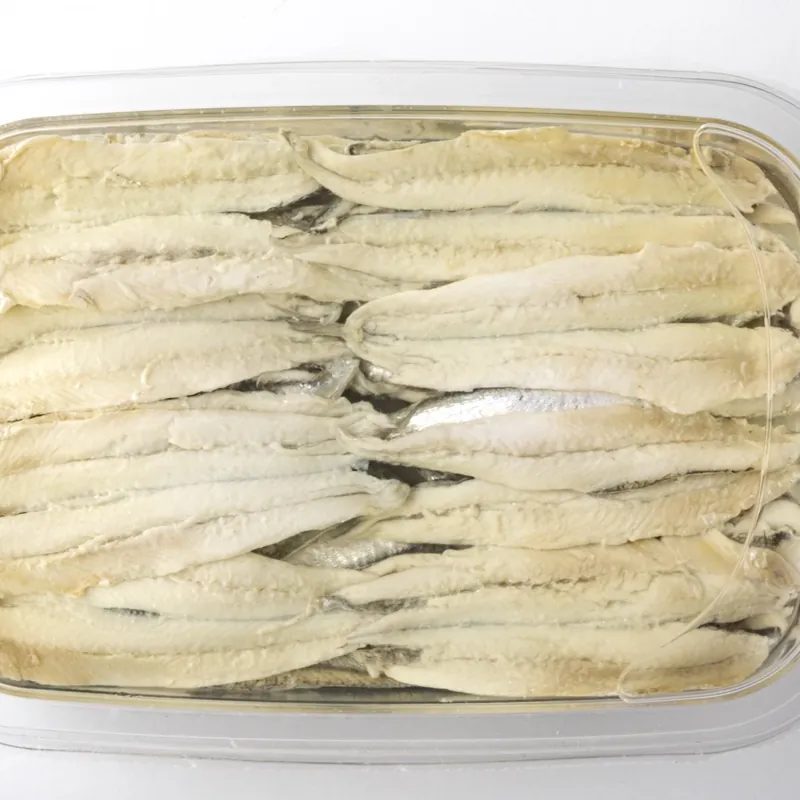
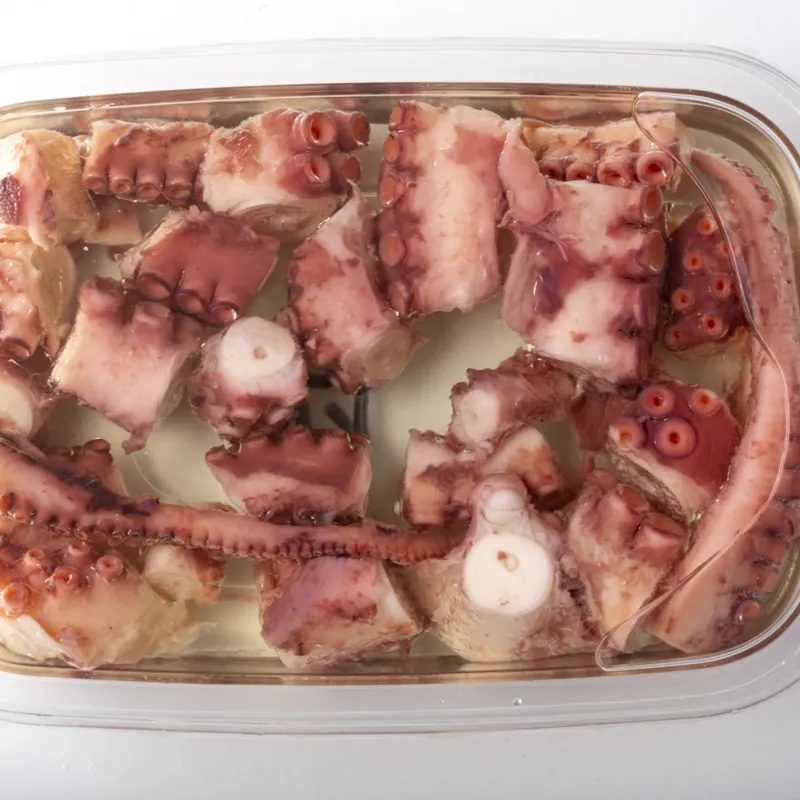
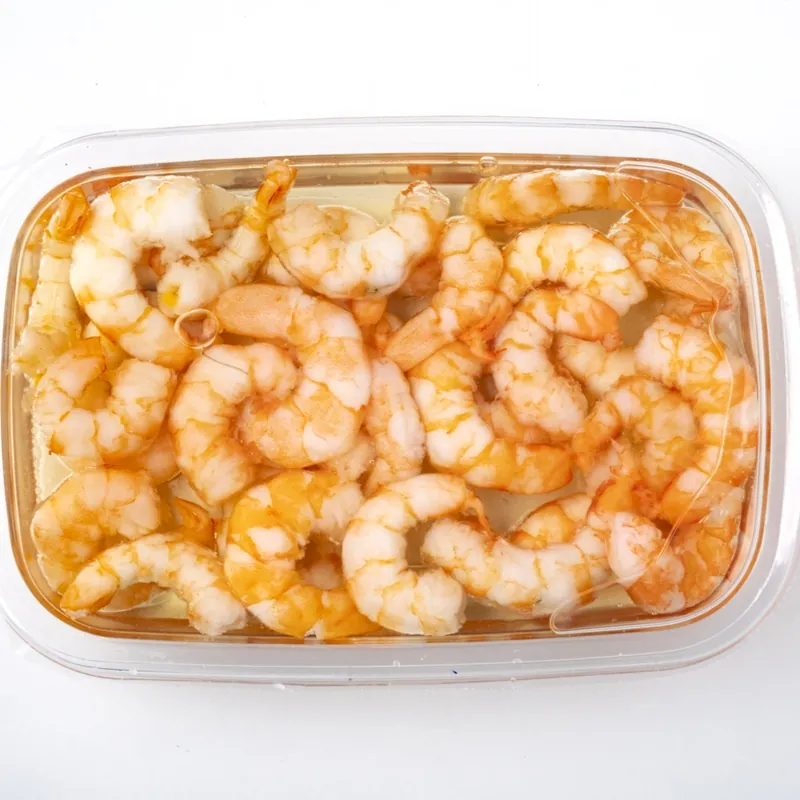
Five references, all 200 g net and 120 g drained, all stored between 0 and +4 °C, all validated at 180 days.
| Reference | Product | Net / drained | Shelf life | Storage |
|---|---|---|---|---|
| LITI7VT003 | Seafood appetizer without vegetables | 200 g / 120 g | 180 days | 0 to +4 °C |
| LITI7VT009 | Marinated anchovy fillets | 200 g / 120 g | 180 days | 0 to +4 °C |
| LITI7VT028 | Marinated octopus | 200 g / 120 g | 180 days | 0 to +4 °C |
| LITI7VT030 | Marinated mussels | 200 g / 120 g | 180 days | 0 to +4 °C |
| LITI7VT017 | Marinated shrimps | 200 g / 120 g | 180 days | 0 to +4 °C |
Packed six units per box, 288 boxes per pallet, 1,728 units per pallet. Eleven references were originally quoted from our producer network; the buyer’s category team narrowed the range to five after tasting the samples.
The result
The purchase order arrived on 29 December 2025: five references, thirty cartons each, one hundred and fifty cartons in total, every item confirmed as duly registered with the SFDA.
It was not an instruction to produce. It was an instruction to complete four more documents first, with an explicit condition that no production begin until all four were approved: a proforma invoice on the buyer’s own template, a new vendor account opening form with bank details signed and stamped by the company and countersigned by the Chamber of Commerce, an Arabic sticker sample for each individual item, and the completed import file supporting the permit application.
For an exporter without a back office, this is the stage where orders quietly die. Chamber of Commerce authentication takes time. Bank documentation takes time. Arabic artwork proofs take revisions. Each one is trivial in isolation and fatal in aggregate when nobody owns the file. We owned it. The order shipped.
Timeline
| Date | Milestone |
|---|---|
| 16 Oct 2025 | Buyer’s inspection office requests samples and proof of SFDA fish exporter registration |
| 17 Oct 2025 | SFDA establishment accreditation confirmed and certificate sent |
| 21 Oct 2025 | Shortlist confirmed, prohibited-ingredient screen run, “wine vinegar” error corrected |
| 23–28 Oct 2025 | Customs documentation and invoice wording agreed for the sample shipment |
| 4 Nov 2025 | Chilled samples shipped with gel packs and thermal box |
| 11 Nov 2025 | Samples received and under category team review |
| 18–19 Nov 2025 | CIF Jeddah quoted by air; buyer confirms no air route for chilled fish from Italy |
| 20 Nov 2025 | Shelf life validated at 180 days, order switched to sea freight, organic declaration corrected, SFDA registration begins |
| Dec 2025 | All five references duly registered at SFDA |
| 29 Dec 2025 | First purchase order issued: five references, 150 cartons |
| Q1 2026 | Vendor onboarding, Arabic artwork approval, import file completed, order shipped |
Three things worth taking from this project, whichever category you buy
Check the establishment list before you check the price list. A product from a plant that is not SFDA-approved for its category cannot be sold in Saudi Arabia, and no commercial negotiation changes that. Ask for the approval number first. It takes one email and it saves months.
Treat the specification sheet as a commercial document. Shelf life, storage temperature and drained weight are not technical trivia to be copied from an old file. Here the shelf-life figure determined the freight mode, and the freight mode determined whether the deal was viable at all.
Budget for the label rebuild. If you are quoting a Gulf buyer on European artwork, you are quoting the wrong job. The Saudi nutrition panel is a different format with different mandatory fields, and private label adds another approval loop on top.
If you are building an Italian range for Saudi Arabia or the wider Gulf, our Middle East market page covers the categories we ship into the region and the compliance work each one carries.
Frequently asked questions
What documents are required to export food to Saudi Arabia?
At minimum: proof that the manufacturing establishment appears on the relevant SFDA approved-establishment list; an SFDA product registration number for each individual SKU; an import permit application on the importer's letterhead with proof of fee payment, commercial register copy and invoice; a six-month export plan naming products by scientific species; full technical sheets with microbiological and chemical-physical values; Arabic label artwork in the Saudi nutrition format; and a commercial invoice and packing list, signed and stamped.
Does an SFDA-approved factory mean my products are approved?
No. Establishment accreditation and product registration are separate gates. An approved plant may still have unregistered products, and each reference must be registered individually and receives its own registration number before it can be imported.
Can I translate my European label into Arabic for Saudi Arabia?
No. The Saudi label uses a percentage Daily Value nutrition panel referenced to a 2,000 kcal diet and requires fields the European label does not carry, including trans fats, cholesterol, dietary fibre, added sugars and sodium in milligrams. The label has to be rebuilt to that format, with a bilingual allergen declaration and separate production and expiry date fields.
Why does shelf life matter so much for chilled food shipped to the Gulf?
Because it determines the freight mode and therefore the landed cost. A chilled product with a short declared shelf life cannot survive sea transit with enough remaining life for the buyer on arrival, which forces air freight. Extending validated shelf life can move an order from air to sea and change the commercial viability of an entire programme.
Which ingredients are prohibited in food imported into Saudi Arabia?
Buyers typically screen against a list covering wine, alcohol, pork and derivatives, rum, ginseng, poppy seeds, hemp and nutmeg, alongside specific additives including E102, E110, E122, E129, E131, E153, E171 and E952. Screen the ingredient declaration in every language version, not only the original, since a translation error can introduce a prohibited term into an otherwise compliant product.
How long does it take to get an Italian food product into Saudi retail?
In this project, ten weeks from first enquiry to a confirmed purchase order, with product registration completed in December and artwork approval and vendor onboarding running into the following quarter. That assumed the producer was already on the SFDA establishment list. Without that, add the accreditation process, which runs between competent authorities and is measured in months.
Ready to source your next Italian product with us?
The buyer in this case study is referenced anonymously at their request. Commercial terms, pricing and product registration numbers are withheld. Regulatory requirements described reflect the documentation required in this project during 2025 and 2026 and should be verified against current SFDA guidance.